Pope defrocks priest over 'visions' of the Virgin Mary
By Simon Caldwell
Last updated at 12:09 AM on 27th July 2009
Comments (15) Add to My Stories The Pope has defrocked the priest at the centre of claims that the Virgin Mary has been appearing in the Bosnian town of Medjugorje.
The Vatican stripped Father Tomislav Vladic of his priest status after an investigation into growing concerns over the alleged apparitions.
Father Vlasic was named as the 'creator' of the phenomenon by Pavao Zanic, the local bishop at the time the apparitions began in 1981.
Angry: Pope Benedict XVI, who recently broke his wrist after slipping in the bath, has removed Father Tomislav Vlasic from the priesthood
In the midst of a spat with the local bishop and the Vatican, he had earlier made a prophecy that the Virgin Mary would appear in Bosnia.
Months later, six local children said they had seen the Virgin on a nearby hillside. Soon after Father Vlasic announced he was 'spiritual adviser' to the 'visionaries' who now claim that Our Lady has visited them 40,000 times over the last 28 years.
An estimated 30million pilgrims have visited the shrine since 1981, including many from Britain and Ireland.
Cardinal Joseph Ratzinger, now Pope Benedict, issued a ban on pilgrimages to the site but this has been widely ignored.
Father Vlasic was suspended last year by the Vatican's Congregation for the Doctrine of the Faith amid an inquiry into his conduct after three commissions failed to find evidence to support the visionaries' claims.
Apparitions: The shrine in Medjugorje, Bosnia is regularly visited by pilgrims.
The Vatican also began an inquiry into claims he was guilty of sexual immorality after he made a nun pregnant.
The defrocking was secretly signed off by the Pope in March.
Father Vlasic refused to cooperate with the investigation from the outset and he was banished to a monastery in L’Aquila, Italy, where he was forbidden to communicate with anyone, even his lawyers, without the permission of his superior.
It emerged yesterday that he has chosen to leave the priesthood and his order, a move which has brought the investigation to an abrupt halt.
The defrocking of Father Vlasic means he is stripped of his priest status.
This represents a massive blow to millions of Medjugorje followers worldwide who were hoping that the Vatican would one day legitimise the controversial shrine.
The seers have grown wealthy as a result of their claims – and so has their town, which has boomed as a result of the ‘Madonna gold rush’.
Some today own smart executive houses with immaculate gardens, double garages and security gates, and one has a tennis court.
They also own expensive cars and have married, one of them, Ivan Dragicevic, to an American former beauty queen.
Tuesday, July 28, 2009

Thursday, July 23, 2009
Muslims desecrate Sacred Host
Muslims desecrate Sacred Host
CHRISTIANS have been formed in the way of God’s love as taught by Jesus Christ. There is a sense of wellbeing and mature disposition in most of the Christians who are always ready to forgive in the way of the Lord Jesus.
Jesus, in his life on earth as the revelation of God, showed the Father’s merciful love and forgave those who sinned against God and humanity. Even at the moment of his arrest by the civil and religious authorities in a lonely place where he was conversing with God the Father, Jesus corrected Peter for cutting off one of the soldier's ear. Jesus, who is merciful and loving, immediately touched and healed the soldier by attaching his chopped ear without any surgery, (see John 18:10 and Luke 22: 51)
Human history tells us that there will always be people who may be misguided by teachings that are not in accordance with the will of God. But God will always elect from among his people some prophets, who will proclaim the true teachings of God, which are experienced in our cultures as peace and love among the people.
But in Malaysia, we are developing a strange culture of “god competition”. It is like the way the children boast to one another of their father’s physical prowess or ability: “My father is great; my father can beat your father”. This is seen in the way government bodies and groups of persons violate the dignity of the human persons and defy the people’s particular laws and customs and subject them to unjust laws. Aren’t these reminiscent of our childish ways? Such attitudes or bully tactics are manifested when some of the nation’s laws are enforced inappropriately and according to the political expediency of ‘powers that be’ of the time. Such socio-political and culture behaviour goes against the common law as well as the United Nations Charter of Rights and our esteemed Federal Constitution.
Because of such blatant violations over the years, Christians are beginning to echo the words of Jesus Christ, when he said, “If I have spoken wrongly, testify to the wrong. But if I have spoken rightly, why do you strike me?” (Jn 18:23).
And so some Christians have lodged police reports recently at the Police Stations around the country against the offensive behaviour of some Muslims who have hurt the Christians deeply. The story of this behaviour was highlighted by Al-Islam of May 2009, with the headlines; Mencari kesahihan remaja Melayu murtad, pages 28-30.
These Muslims consumed the “Holy Communion” and spat out the sacred host. They humiliated the Catholics by having it photographed and its image published in the monthly Al-Islam. This is a violation of Christians in Malaysia and challenges the nation's Federal Constitution. Is Malaysia a secure land where all religions can practice their religion in peace and tranquility? Will the police (PDRM) and AG’s chambers bring those Muslims to court? As guardians of just laws will they carry out their noble task and honour the Law of our nation Malaysia? This desecration speaks against the 1Malaysia project of the Prime Minister.
From the very beginning of the Church, the Fathers of the Church and approved theologians have addressed the Church’s serious concern that due respect be paid to the Most Blessed Sacrament, that souls not fall into the sin of sacrilege by receiving the Body and Blood of Christ unworthily.
Those Muslims who have desecrated the Sacred Host have just done that — received the Body and Blood of Christ unworthily.
This is a very serious offence to our Christian Faith, and we support the efforts of Sudhagaran Stanley and Joachim Francis Xavier for their courageous stand in highlighting this sacrilegious act of certain Muslims and we call on the Catholic Lawyers’ Society to follow this through by taking the appropriate action and ensuring that such events do not take place.
As the incident committed by those Muslims was a willful act of desecration of the Sacred Host, the Body of Christ, it is proper that we, the Catholics, make reparation for the offence committed against the Lord. It should not be seen as a single incident since there have been many such instances of this nature taking place in other churches and going unreported. Therefore, it is the duty of the parish priests of those churches where such sacrilegious acts have been committed to do the necessary acts of reparation and also forgive those Muslims and pray for them.
Let us receive the Lord worthily always.
(This article is published on The Herlad Malaysia online edition www.heraldmalaysia.com on 16b July 2009 and used with acknowledgement.)
Tuesday, July 21, 2009
Christiano: Quo Vadis?
Middle East Christians hit the road
By Stephen Starr
DAMASCUS - Attacks on six churches in Iraq early this month and the targeting of Christians across the country have served as a microcosm of the difficulties facing Christians in the Middle East today. Migration, whether forced or to pursue a better life and employment opportunities elsewhere, has seen Christian numbers in the Middle East drop dramatically.
in 1948 Jerusalem was about one-fifth Christian but today that number stands at 2%, the New York Times reported in May. In Bethlehem, the birthplace of Jesus Christ, Christians now account for about 30% of the population, where they once made up around 80% of its inhabitants. In Lebanon, where Christians continue to hold significant political and social sway, their numbers are considerably higher than elsewhere in the region but are believed
to be falling. A region that a century ago was 20% Christian is about 5% today, with the figures still dropping fast.
Uneasy existence for Christians
The rise of political Islam and conservative thought across the region has been regarded as a refutation of an all-encroaching and consuming globalization. Radical Islam has also been identified as a political body with which to oppose a West whose interests in the Middle East have led it to be perceived as an exploiter and as responsible for the damage brought to Iraq and the Palestinian territories and for the siphoning off of oil.
Religion has become more politicized, and with divisions between Islam and the West gaining currency across the world, Christians in the Middle East increasingly feel caught in the middle. Identity has become a major issue for Muslims as a sense of inferiority (in terms of technology and popular culture) and attack reverberate around a region where foreign powers have attempted to conquer and collude for centuries. As a consequence of being a minority and as their numbers continue to shrink, Christians often feel vulnerable in a region that gave birth to the faith of 33% of the entire world.
During his visit to the Holy Land in May this year, Pope Benedict XVI lamented, "While understandable reasons lead many, especially the young, to emigrate ... the departure of so many members of the Christian community in recent years" is a "tragic reality".
Asaad Abrash, who lives in Saidnaya, a Christian town 35 kilometers north of Damascus, said, "Of course we as Christians identify ourselves with Europe and even America because of our religion. The fact that there are well-paying jobs in the West means that even in spite of visa difficulties, the lure is very strong."
Aiham Farah, who lives in the wealthy Christian neighborhood of Kassaa in Damascus, said the reasons for leaving are obvious. "My brother has been living and working as a doctor in the US for over eight years: 80% of doctors who graduate from the medical school here go abroad to continue their education and the States is one of the best places for that.
"The American government has a policy of granting them permanent residency and they can earn salaries unimaginable in Syria, so it's hard for them to get back home after finishing because of the situation they got used to [in terms of] living and everything prevent them from starting over in their home country. So they just think about visiting here. Work is more stable, education is better there so it's hard to see my brother coming back."
Christians in Iraq: Undercurrent of violence
In Iraq, the fall of the Ba'ath regime and the violence that followed have seen sectarianism spiral as Sunni and Shi'ites have engaged in regular partisan attacks for years. Though less documented, Christians have also been targeted. Half of Iraq's 1.4 million Christians have reportedly fled the country since the US-led invasion in 2003, although accurate figures are difficult to track down.
On July 12, the Church of the Sacred Heart in Baghdad's al-Mohandiseen district was the scene of a car bomb that killed four people. During a 48-hour period, 32 other people were wounded in seven attacks in different parts of the country, leading to re-imposed curfews in the Christian towns of Hamdaniyah and Talkif, close to Mosul. In the same period, a Christian government official, Aziz Rizko Missan, was shot dead in the northern city of Kirkuk.
"I fear the extinction of Christianity in Iraq and the Middle East," said Jean Benjamin Sleiman, the Catholic archbishop of Baghdad, following the attacks on Christians.
More than 10 Christian sects are scattered, mainly in Damascus, Aleppo and the midlands, making up almost 10% of Syria's population. Substantial efforts have been made to portray Syria as a sanctuary of toleration compared with neighboring Lebanon, Iraq and in the Palestinian territories, where religious-fueled violence has been going on for years. "Syria is the best country for any Christian to live in the Middle East - people don't differentiate between each other's religion and that has been the reason why things are so bad in the Middle East," said Farah.
In other countries, however, little has been done to stem the tide of Christian emigration. For governments in the Middle East, there is good reason for that. "We're not so sure we want our expats to return because they provide an important source of money through remittances that run down through the whole economy," said Abdullah Dardari, Syria's deputy prime minister for economic affairs.
In a region that is home to the most important historical sites for Christians, many in the region fear bringing attention to their religion. Julia, a Syriac Catholic, moved back with her family to Syria after living in the United States for several years. Preferring not to reveal her full identity, she said, "As a Christian living in a Muslim country, there are many things that I have to think about before I go out. For example, the culture affects how I dress. If I want to go to the store, work or even to my university, I need to make sure I don't wear something that might draw attention to myself. I think it also affects where I work; a couple of years ago I had an interview for a job where I appeared to fit the profile of the type of employee they needed but I didn't get the job. I think it was because I'm a Christian and all the employees were covered. Sometimes, I feel that I shouldn't wear my cross necklace if I'm out in public in certain areas of the city such as on the bus or non-Christian areas."
For some Christians there is a sense of duty to stay in the Middle East, it being the birthplace of the religion. "When I came to visit, I noticed this gap right away, but I stayed true to my religion because I'm proud to be a Christian - even in this country," said Julia.
Stephen Starr is a freelance journalist.
(Copyright 2009 Asia Times Online (Holdings) Ltd. All rights reserved. Please contact us about sales, syndication and republishing.)
By Stephen Starr
DAMASCUS - Attacks on six churches in Iraq early this month and the targeting of Christians across the country have served as a microcosm of the difficulties facing Christians in the Middle East today. Migration, whether forced or to pursue a better life and employment opportunities elsewhere, has seen Christian numbers in the Middle East drop dramatically.
in 1948 Jerusalem was about one-fifth Christian but today that number stands at 2%, the New York Times reported in May. In Bethlehem, the birthplace of Jesus Christ, Christians now account for about 30% of the population, where they once made up around 80% of its inhabitants. In Lebanon, where Christians continue to hold significant political and social sway, their numbers are considerably higher than elsewhere in the region but are believed
to be falling. A region that a century ago was 20% Christian is about 5% today, with the figures still dropping fast.
Uneasy existence for Christians
The rise of political Islam and conservative thought across the region has been regarded as a refutation of an all-encroaching and consuming globalization. Radical Islam has also been identified as a political body with which to oppose a West whose interests in the Middle East have led it to be perceived as an exploiter and as responsible for the damage brought to Iraq and the Palestinian territories and for the siphoning off of oil.
Religion has become more politicized, and with divisions between Islam and the West gaining currency across the world, Christians in the Middle East increasingly feel caught in the middle. Identity has become a major issue for Muslims as a sense of inferiority (in terms of technology and popular culture) and attack reverberate around a region where foreign powers have attempted to conquer and collude for centuries. As a consequence of being a minority and as their numbers continue to shrink, Christians often feel vulnerable in a region that gave birth to the faith of 33% of the entire world.
During his visit to the Holy Land in May this year, Pope Benedict XVI lamented, "While understandable reasons lead many, especially the young, to emigrate ... the departure of so many members of the Christian community in recent years" is a "tragic reality".
Asaad Abrash, who lives in Saidnaya, a Christian town 35 kilometers north of Damascus, said, "Of course we as Christians identify ourselves with Europe and even America because of our religion. The fact that there are well-paying jobs in the West means that even in spite of visa difficulties, the lure is very strong."
Aiham Farah, who lives in the wealthy Christian neighborhood of Kassaa in Damascus, said the reasons for leaving are obvious. "My brother has been living and working as a doctor in the US for over eight years: 80% of doctors who graduate from the medical school here go abroad to continue their education and the States is one of the best places for that.
"The American government has a policy of granting them permanent residency and they can earn salaries unimaginable in Syria, so it's hard for them to get back home after finishing because of the situation they got used to [in terms of] living and everything prevent them from starting over in their home country. So they just think about visiting here. Work is more stable, education is better there so it's hard to see my brother coming back."
Christians in Iraq: Undercurrent of violence
In Iraq, the fall of the Ba'ath regime and the violence that followed have seen sectarianism spiral as Sunni and Shi'ites have engaged in regular partisan attacks for years. Though less documented, Christians have also been targeted. Half of Iraq's 1.4 million Christians have reportedly fled the country since the US-led invasion in 2003, although accurate figures are difficult to track down.
On July 12, the Church of the Sacred Heart in Baghdad's al-Mohandiseen district was the scene of a car bomb that killed four people. During a 48-hour period, 32 other people were wounded in seven attacks in different parts of the country, leading to re-imposed curfews in the Christian towns of Hamdaniyah and Talkif, close to Mosul. In the same period, a Christian government official, Aziz Rizko Missan, was shot dead in the northern city of Kirkuk.
"I fear the extinction of Christianity in Iraq and the Middle East," said Jean Benjamin Sleiman, the Catholic archbishop of Baghdad, following the attacks on Christians.
More than 10 Christian sects are scattered, mainly in Damascus, Aleppo and the midlands, making up almost 10% of Syria's population. Substantial efforts have been made to portray Syria as a sanctuary of toleration compared with neighboring Lebanon, Iraq and in the Palestinian territories, where religious-fueled violence has been going on for years. "Syria is the best country for any Christian to live in the Middle East - people don't differentiate between each other's religion and that has been the reason why things are so bad in the Middle East," said Farah.
In other countries, however, little has been done to stem the tide of Christian emigration. For governments in the Middle East, there is good reason for that. "We're not so sure we want our expats to return because they provide an important source of money through remittances that run down through the whole economy," said Abdullah Dardari, Syria's deputy prime minister for economic affairs.
In a region that is home to the most important historical sites for Christians, many in the region fear bringing attention to their religion. Julia, a Syriac Catholic, moved back with her family to Syria after living in the United States for several years. Preferring not to reveal her full identity, she said, "As a Christian living in a Muslim country, there are many things that I have to think about before I go out. For example, the culture affects how I dress. If I want to go to the store, work or even to my university, I need to make sure I don't wear something that might draw attention to myself. I think it also affects where I work; a couple of years ago I had an interview for a job where I appeared to fit the profile of the type of employee they needed but I didn't get the job. I think it was because I'm a Christian and all the employees were covered. Sometimes, I feel that I shouldn't wear my cross necklace if I'm out in public in certain areas of the city such as on the bus or non-Christian areas."
For some Christians there is a sense of duty to stay in the Middle East, it being the birthplace of the religion. "When I came to visit, I noticed this gap right away, but I stayed true to my religion because I'm proud to be a Christian - even in this country," said Julia.
Stephen Starr is a freelance journalist.
(Copyright 2009 Asia Times Online (Holdings) Ltd. All rights reserved. Please contact us about sales, syndication and republishing.)
Wednesday, July 15, 2009
A New Benedict for a New Dark Ages, by Thaddeus J. Kozinski
A new Benedict for a new Dark Ages
The Pope's latest encyclical is another skirmish in his war on the moral relativism which undermines our culture.
 I bet it never crossed the minds of many living during the Dark Ages that they were particularly dark, or of those living during the decline and fall of the Roman Empire that it was speedily declining, let alone falling. Since the Owl of Minerva flies at dusk, and hindsight is 20/20, it appears to be an inexorable law of both history and human nature that men recognize the "signs of the times" only after those times have passed.
One of the most astute "sign readers" of today is the reigning Pope. Here is one of Benedict XVI’s most startling yet accurate readings: "We are moving toward a dictatorship of relativism which does not recognize anything as for certain and which has as its highest goals one’s own ego and one’s own desires." If I might put it into less philosophical terms, what the Holy Father is telling us is that Western culture is descending into barbarism.
We tend to associate barbarism with images of primitive savages looting and pillaging villages, razing the walls of cities, and enslaving women and children. However, the Holy Father is suggesting here an entirely new kind of barbarism, one with a distinctly spiritual character. Civility is the quality of soul and society by which we recognize not only that other people exist, but also that they have the right to our courtesy, dignity, and respect. Civilization, then, as the opposite of barbarism, is founded upon the recognition of the dignity and rights of the other. Thus, a culture in which "the highest goals [are] one’s ego and one’s own desires" is the very definition of barbaric.
G.K. Chesterton notes, "The simple sense of wonder at the shapes of things, and at their exuberant independence of our intellectual standards and our trivial definitions, is the basis of spirituality." Today’s barbarism is of a distinctly spiritual nature. It is not so much a physical as a philosophical barbarism that has overtaken Western culture, a barbarism of the soul that is camouflaged by a quite "civilized" bodily façade. Fr John Courtney Murray observed:
The barbarian need not appear in bearskins with a club in hand. He may wear a Brooks Brothers suit and carry a ball-point pen with which to write his advertising copy. In fact, even beneath the academic gown there may lurk a child of the wilderness, untutored in the high tradition of civility, who goes busily and happily about his work, a domesticated and law-abiding man, engaged in the construction of a philosophy to put an end to all philosophy, and thus put an end to the possibility of a vital consensus and to civility itself.
The most dangerous philosophical barbarians today are not the relatively few fanatical atheists and dogmatic relativists in academe, the courts, the government, and the media, but the much more prevalent "practically minded" sort. These do not deny the existence of other people, but live as if they didn’t exist or had no worth compared to their own; they are not certain that God does not exist, or that the true, the good and the beautiful are illusions; yet if He did happen to exist, and if transcendentals were real, it wouldn’t really matter much to their lives.
Feeding the hungry; instructing the ignorant
The philosophical barbarian does not wish to have any external demands imposed upon him, for he desires all of reality to conform to his presuppositions, prejudices, and plans. He is unwilling to open his soul fully to the objects and entities around him, for he does not trust that any good will come to himself from such vulnerability. Instead of accepting the imposition of an objectively real world with infinite plenitude and profundity, he imposes upon it his paltry perspective, thereby rejecting a rich, resplendent reality for a scanty and superficial one. He reduces reality to the size of his shrunken soul. Since the less there is to know, the less there is to love, the end result of this barbaric state of soul, tantamount to staring at one’s spiritual navel, is perpetual, relentless boredom. Michael Hanby writes:
A world that is "beyond good and evil," in which nothing is either genuinely good or genuinely bad, and no truth, goodness, or beauty are revealed, is a world in which nothing is either intrinsically desirable or detestable. Such a world affords no possibility of seeing and using things as holy, which means to some degree letting them be, because in such a world there can be no holy things. Boredom is therefore the defining condition of a people uniquely in danger of losing their capacity to love, that is, a people uniquely in danger of failing to grasp "the mystery of [its] own being" and losing its very humanity.
Boredom is the telltale sign of the starving soul, and today’s barbarians are starving for the two staple soul-foods: knowledge and community. Modern secular culture feeds its denizens plenty of "knowledge" in the form of technological know-how, scientific facts, ephemeral trivia, and politically correct aphorisms, but this is paltry fare with little nutritional value compared to the sumptuous banquet of truth they could have if they only recognized their hunger for it: they desire "know-how" regarding their souls; they pine for the meaning of things, not just for facts; they yearn to partake in the complex and elegant conversation with "the best that has been thought and said" that we call the Great Books, not politicized and pre-digested cant.
The new barbarians, however, are "people of the screen," who have all but lost the art of reading, thinking, and conversation due to an overexposure to flashing images, meandering chatrooms, and Facebook friendships. They have become, to use T.S. Eliot’s stark phrase, "hollow men":
Only a flicker
Over the strained time-ridden faces
Distracted from distraction by distraction
Filled with fancies and empty of meaning
Tumid apathy with no concentration
Men and bits of paper, whirled by the cold wind
That blows before and after time,
Wind in and out of unwholesome lungs
Time before and time after.
Immersed in the digitized echoes of iPods but not the music of birds, in the virtual vertigoes of the video game but not the cloud-tipped/dizzying mountain top, they are starving for intimacy with the living, breathing Creation; the abstract, vicarious, two-dimensional dose of documentary, regardless of its cinematic quality, is like touching a ghost compared to the visceral, toes-in-the-dirt, exhilarating experience of immersing one’s five senses in the splendor of reality.
Most of all, these barbarians are starving for friendship, for intimacy, for communion. Growing up in dysfunctional families as orphans in their own homes, in neighborhoods where no one knows each other, in rootless communities in perpetual emigration, and in cities and suburbs where the empty blandishments of consumerism and mall shopping are what passes for festival; their desire for authentic friendship—to know and be known—has become rapacious.
Nevertheless, the intellectual junk-food that pop-culture and mainstream education has been feeding them since their youth has become satisfying, for their souls have shrunk in adjustment, and they have never tasted rich spiritual food by contrast with which they could detect the other as counterfeit. Because of this, as German philosopher Josef Pieper suggests, they have made their peace with illusions:
For the general public is being reduced to a state where people not only are unable to find out about the truth but also become unable to search for the truth because they are satisfied with deception and trickery that have determined their convictions, satisfied with a fictitious reality created by design through the abuse of language.
Today’s barbarians, with all their myriad choices, are in truth choiceless, for they do not themselves feel chosen in their heart of hearts, as the great conservative Jewish sociologist Philip Rieff has written:
There is no more feeling more desperate than that of being free to choose, and yet without the specific compulsion of being chosen. After all, one does not really choose; one is chosen. This is one way of stating the difference between gods and men. Gods choose; men are chosen. What men lose when they become as free as gods is precisely that sense of being chosen, which encourages them, in their gratitude, to take their subsequent choices seriously.
We have all, barbarian or not, been chosen to become something beautiful, unique, and irreplaceable—the image of God on earth and an instrument of His love. It is the ignorance of this truth, perhaps caused by lack of acquaintance with its living embodiments, that is the worst barbarism of all.
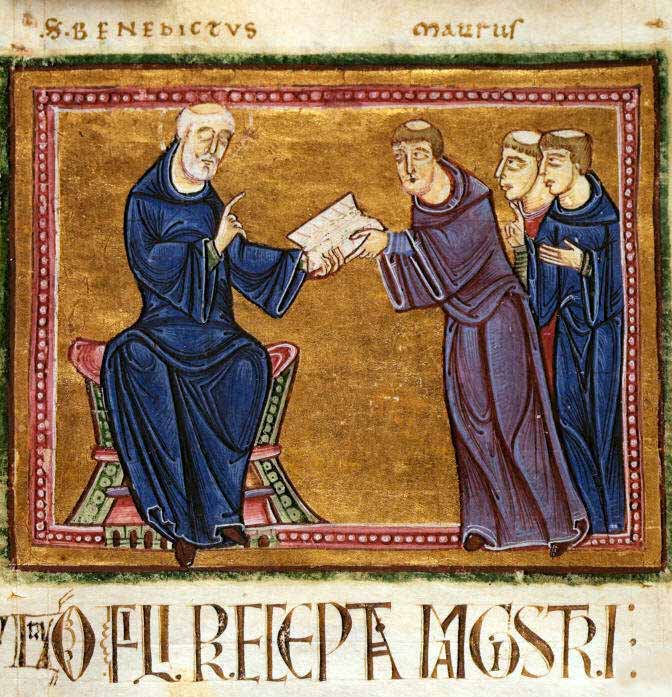
A new St Benedict for the new Dark Ages
If our reading of the signs of the times is correct, then what we are moving towards—and perhaps have already arrived at—is the fall of Western classical and Christian civilization, the emergence of a sophisticated spiritual barbarism that makes the barbarism of the past look like high-culture, and a new Dark Ages. Is it too late to save it? It is certainly far past preventive measures, for our culture is already in the late stages of its terminal illness. But with the grace of God, it is not too late for a miraculous healing and full recovery—even a resurrection—if only we could find the right cultural medicine and plenty of trained doctors to administer it. Time is running out, for the darkness is fast approaching, nay, is already here. Alasdair MacIntyre, one of the preeminent philosophical doctors of our time, offers his diagnosis and prescription:
What they set themselves to achieve instead was the construction of new forms of community within which the moral life could be sustained so that both morality and civility might survive the coming ages of barbarism and darkness... What matters at this stage is the construction of local forms of community within which civility and the intellectual and moral life can be sustained through the new dark ages which are already upon us.
The "they" MacIntyre refers to here are St Benedict and his followers, men who had read carefully the signs of their 6th Century times, the first Dark Ages, and acted accordingly. As the darkness of barbarism approached, they fled to the desert, carrying with them as much of the precious Christian and classical civilization as they could hold in their souls. These were the seeds that, due to the pure water of their prayers, the luminous light of their labors, and the rich soil of their studies, would flower six centuries later as the civilization we call Christendom. Alasdair MacIntyre ends his stupendous analysis of modern culture, After Virtue, by calling for a new St Benedict to lead the barbarians out of the spiritual desert that is our godless, technocratic, secular culture to plant the seeds for a new Christendom.
In truth, we do have a new Benedict in our midst, and his name is Joseph Ratzinger: Pope Benedict XVI. An expert reader of the "signs of the times," it is no wonder that the world, in spite of its protestations of disbelief, still looks to the Pope for spiritual guidance.
Caritas in Veritate, "Charity in Truth." Our new Benedict’s encyclical is out, and its essential message, the power of love in truth and truth in love, when practiced, is precisely what could convert us love-sick and truth-starved barbarians. President Obama would do well to heed this encyclical’s wisdom: "Without truth, charity degenerates into sentimentality." "Truth, in fact, is lógos which creates diá-logos, and hence communication and communion." "Fidelity to man requires fidelity to the truth, which alone is the guarantee of freedom (cf. Jn 8:32) and of the possibility of integral human development." "Only in charity, illumined by the light of reason and faith, is it possible to pursue development goals that possess a more humane and humanizing value."
Let us answer our new Benedict’s clarion-call to topple the dictatorship of relativism and help usher in a new civilization of love under the reign of God in these new—and perhaps last!—dark ages. Perhaps you have been chosen to become one of the philosophical doctors and spiritual healers our diseased and emaciated culture desperately needs. The starving barbarians need you!
Dr Thaddeus J. Kozinski is Assistant Professor of Humanities at Wyoming Catholic College, in Lander, Wyoming
Subscribe to:
Posts (Atom)
